
On December 29. 1946, Keener’s predecessor, WKMH debuted. In 1966, The Detroit News reported a Dearborn Founders’ Day celebration of Keener’s 20 years of service. It’s a fascinating history of the station we still celebrate today. Thanks to Kim Sulek for sending us the original article, transcribed below.
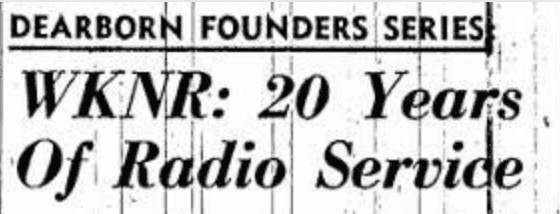
 WKNR: 20 years of radio service
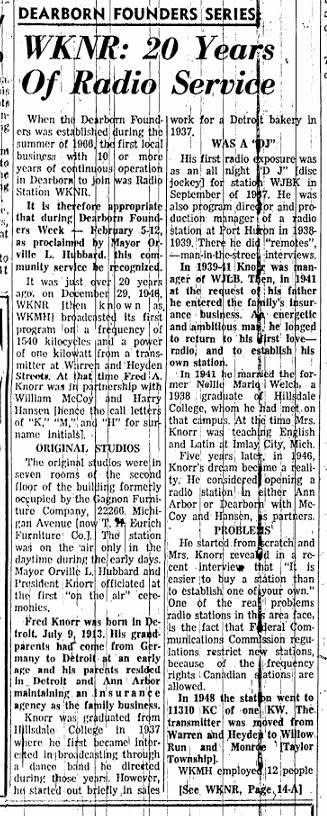
When Dearborn Founders was established during the summer of 1956, the first local business with 10 or more years of continuous operation in Dearborn to join was radio station, WKNR. It is therefore appropriate that during Dearborn Founder’s Week, February 5-12 as proclaimed by Mayor Orville L. Hubbard, this community service be recognized.
It was just over 20 years ago, on December 29, 1946, WKNR, then known as WKMH, broadcast its first program on a frequency of 1540 kilocycles at the power of one kilowatt from a transmitter at Warren and Hayden streets. At the time, Fred Knorr was in partnership with William McCoy and Harry Hansen.
Hence the call letters of K, M, and H for surname initials.
ORIGINAL STUDIOS
The original studios were in seven rooms of the second floor of the building formerly occupied by the Gagnon Furniture Company. 22266 Michigan Avenue, now T.H. Eurich Furniture Company. The station was on the air only in the daytime during the early days. Mayor Orville L. Hubbard, and President Knorr officiated at the first on-air ceremonies, Fred Knorr was born in Detroit, July 9th, 1913. His grandparents had come from Germany to Detroit at an early age, and his parents resided in Detroit and Ann Arbor, maintaining an insurance agency as the family business. Knorr was graduated from Hillsdale College in 1937, where he first became interested in broadcasting through a dance band he directed during those years, however, he started out briefly in sales work for a Detroit bakery in 1937.
WAS A DJ
His first radio exposure was as an all-night DJ [disc jockey] for station WJBK in September of 1957. He was also program director and production manager of a radio station at Port Huron in 1938- 1939.
There he did remotes man in the street interviews in 1939- 41, Knorr was manager of WJLB. Then in 1941 at the request of his father, he entered the family’s insurance business. An energetic and ambitious man, he longed to return to his first love, radio, and established his own station in 1941. He married the former Nelly, Mario Welch, a 1938 graduate of Hillsdale College, whom he had met on the that campus at the time. Mrs. Knorr was teaching English and Latin in Imlay City, Michigan. Five years later, in 1946, Knorr’s Dream became a reality. He considered opening a radio station in either Ann Arbor or Dearborn with McCoy and Hansen as partners.
PROBLEMS
He started from scratch, and Mrs. Knorr revealed in a recent interview that, “It is easier to buy a station than to establish one of your own.” One of the real problems radio stations in this era face is the fact that the Federal Communications Commission regulations restrict new stations because of the frequency rights Canadian stations are allowed. In 1948, the station went to 1310 kilocycles at one kilowatt. The transmitter was moved from Warren and Hayden to Willow Run and Monroe in Taylor Township. WKMH employed 12 people in 1946, but now, as the community and services of the station have grown, approximately 50 people are on the staff. A radio station is a complex and highly technical business, which the layman may not be familiar with. Various aspects of the station include the executive, administrative staff, programming, news, sales department, traffic department, accounting, engineering planning, and more. FCC codes and restrictions are very stringent. Broadcast licenses must be renewed every three years, and it entails much more than just filling out a new application form. Federal inspectors may make unannounced checks at any time.
RELOCATED
In 1950, WKMH received permission to change its daytime power to five kilowatts daytime with a two-tower directional antenna system. Two years later, in February of 1952, the studios were relocated at 15001 Michigan Avenue in the east end of the city. In April, 1964, nighttime power was raised to five kilowatts and a six tower directional system was installed.
From 1956 to 1961, Knorr held a one-third interest in the Detroit Tigers Baseball Club, including one year as president. During his early days in radio, Knorr was interested in sports and broadcasted numerous types of sporting events, including professional ice hockey in Detroit. At one time, Detroit Tiger Games originated from the Dearborn station.
Fred Knorr worked diligently and tirelessly for the success of Dearborn’s only radio station. Unfortunately, he died as a result of severe burns in a mishap at age 47 in 1960. Mrs. Knorr, who had been gradually taking a greater interest in the station, became president in 1960 and has continued to lead the progressiveness of the business, Mrs. Knorr had a survey made of the community needs and it was noted a changing listening audience with different listening habits and interests was apparent. On November 1st, 1963, Mrs. Knorr changed the radio station WKMH, to the call letters, WKNR, in honor of the late Fred Knorr. It took on a new image.
In 1966, an extensive remodeling and expansion program at the stations 15001 Michigan Avenue address became a reality. Today, the facilities are a credit to the community, and the exterior view of the building is eye catching. Through the years, the Knorrs owned stations in Flint – WKMF, Battle Creek – WELL, Saginaw – WSAM, and later, WSAM-FM and Jackson -WKHM, and pioneered CATV [Community and Antenna Television] in these areas to make television reception clearer.
Mrs. Knorr sold her interests in the former three stations some years ago. Although Mrs. Knorr is quite busy with her interest in WKNR, she participates in numerous community projects and has been busy raising her three children, ages 23, 15 and 13. Dearborn founders, Mr. And Mrs. Fred A. Knorr. Have contributed immeasurably to the growth of Dearborn’s communication, entertainment, education, and information since 1946. Mrs. Knorr, recently named Detroit’s “Advertising Woman of the Year,” has followed the tradition established by her husband to make WKNR one of the finest family stations in the nation. The Dearborn founders is interested in preserving the heritage and identity of the business and professional world of Dearborn.
As has been discussed in the above article, it is the earnest hope of the founders, under the steering committee, chairmanship of Florence B King, that other businesses and professions with 10 or more years of local service will compile their record for permanent preservation in the Dearborn Historical Commission files.
What happened then?
Keener’s complicated broadcast pattern and 5,000 watt signal proved to be no match when CKLW mirrored the Drake Top-40 format with 50,000 watts behind it. In April of 1972, the station was sold and the format changed to beautiful music, ultimately becoming the FM powerhouse, WNIC. Keener briefly reappeared as WWKR on the AM dial but is now a specialty format on the fast diminishing AM band.
Steve Schram and Scott Westerman resurrected the Keener brand when this website launched in 2002. Soon after, they began experimenting with a private audio recreation of WKNR. Three years ago, Keener13.com came above the radar, featuring the same energy and a playlist filled with “The Soundtrack” of the Keener generation. To date, over 130,000 unique listeners have sampled the new Keener on smart phones, Alexa devices and web browsers across the country and around the globe.
